
How to Get a Building Permit / Approval in Kenya: Step-by-Step County Guide
By Fundi Link11 min read
County-by-county guide to building permits in Kenya — Nairobi, Kiambu, Mombasa, Nakuru, and Machakos portals, NEMA and NCA steps, documents, and common pitfalls.
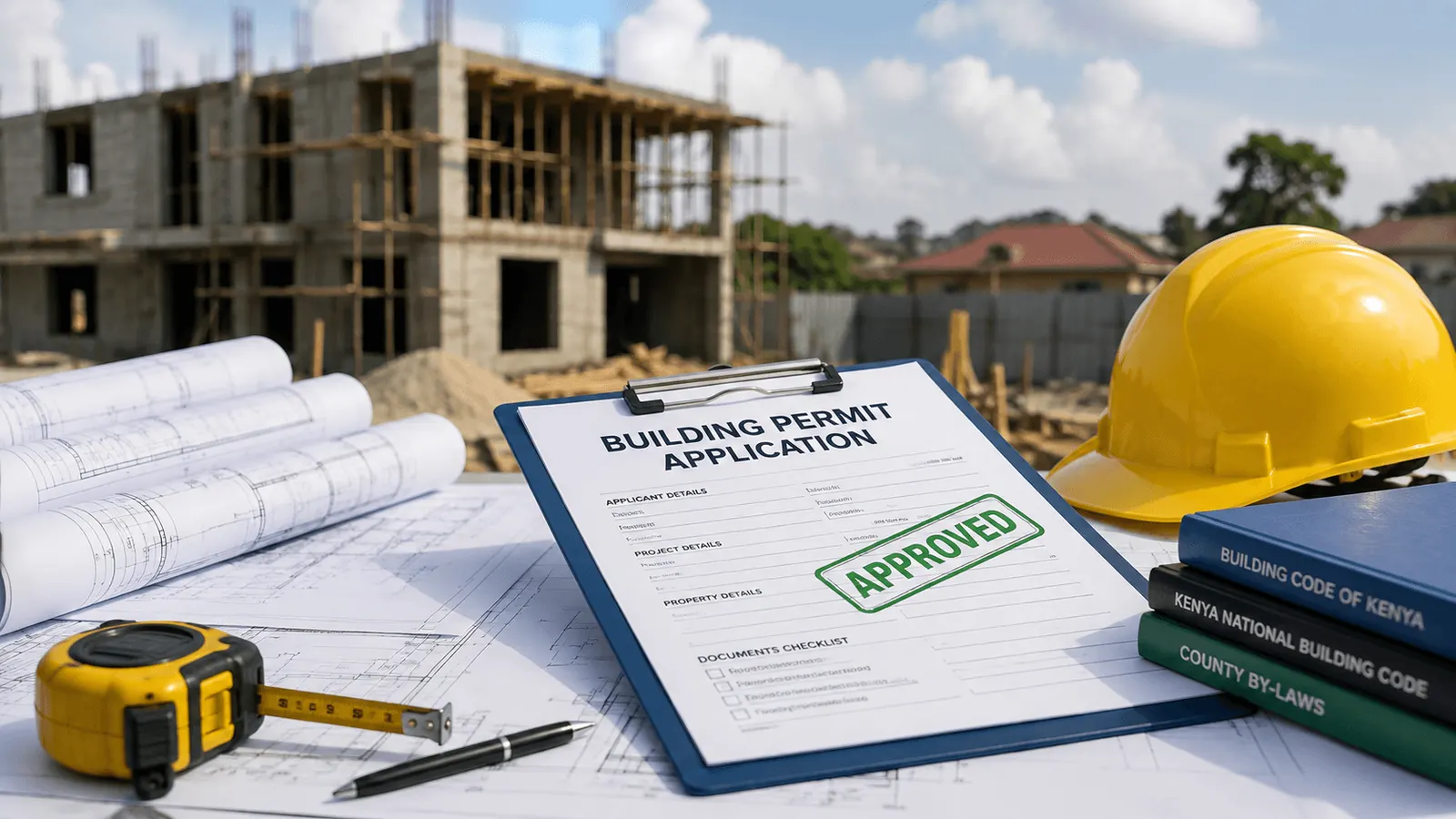
Getting a building permit in Kenya is a county process, not a single national office. Nairobi, Kiambu, Mombasa, Nakuru, and Machakos each run their own development-control desks — with different portals, fees, and timelines. This guide explains the national rules every county must follow, then walks through the major counties step by step.
Last updated: August 2026. County portals and intake methods change — always confirm the live process on your county’s official site before submitting.
Do I need a building permit before I start construction in Kenya?
Yes. Under the Physical and Land Use Planning Act, 2019 (PLUPA), you must obtain development permission from the county where the land sits before carrying out building works. Starting without approval is an offence — the county can issue enforcement notices, require demolition or restoration, and impose fines (up to KES 500,000 and/or imprisonment under Section 57).
A county building permit is separate from NEMA environmental approval and NCA project registration. Most projects need all three layers: county plan approval first, then environmental clearance where required, then NCA registration before the contractor breaks ground.
Which county approves my building plans?
The county government that covers your title deed location approves your plans — not the county where you live or work. Ruiru and Kiambu town fall under Kiambu County, not Nairobi City County, even if the site is “near Nairobi.” Submitting to the wrong portal is one of the most common causes of rejected applications.
If your plot is inside Nairobi City County boundaries, use the Nairobi eDevelopment system. If it is in Mombasa, use Mombasa e-DAMS. Always match the portal to the land registry and survey coordinates on your title.
Step-by-step: how building approval works (any county)
- Hire registered professionals. Architectural drawings must be prepared by a BORAQS-registered architect; structural drawings by an EBK-registered engineer. Counties reject unsigned or unregistered submissions.
- Prepare documents. Typically: copy of title deed or lease, ID/KRA copies, site plan, architectural and structural drawings, bill of quantities (for larger projects), and search from the lands office where required.
- Submit to the county. Online (e-DAMS / eDevelopment) or at the sub-county planning counter — depending on the county’s current intake method.
- Pay prescribed fees. Counties issue an invoice based on plinth area, use class, and estimated cost of works. Rates are set in each county’s Finance Act — they differ from county to county.
- Multi-agency review. PLUPA requires the county to circulate your application to relevant agencies (health, roads, environment, utilities, etc.) within seven days. Agencies comment within 14 days.
- Decision. The county executive committee member may grant or refuse development permission within 30 days of receiving a complete application (Section 61, PLUPA). Track your file online or with your architect.
- NEMA & NCA before construction. After county approval, obtain environmental clearance if your project requires it, register the project with NCA, and use only NCA-registered contractors with valid practising licences.
- Book county inspections at foundation, structural, and completion stages. Request an occupation certificate before occupying the building.
Is it hard to get a construction permit in Nairobi?
It is manageable if your drawings are complete and your land records are clean — but Nairobi is not the fastest county for everyone. The process is fully digitised through the Nairobi Planning and Development Management System (eDevelopment). Incomplete submissions, zoning conflicts, or missing owner consent on leasehold plots are the usual reasons for delays.
Nairobi County operates a no-cash revenue policy for most services; permit fees are paid digitally after the system generates an invoice. Professional bodies (AAK, IEK, etc.) sit on the County Planning and Technical Committee that reviews applications. If your architect has submitted complete PDF drawings and your title matches the site, many residential files move through in a few weeks — but complex commercial or high-rise projects take longer.
Nairobi County — portal, fees, and how to apply
- Development applications portal: edev.nairobiservices.go.ke (Nairobi Planning and Development Management System)
- County payments & other services: nairobiservices.go.ke
- County website & inquiries: nairobi.go.ke · General inquiry form available on the site · Help line listed on the county site: +254 725 624489
How to apply: Your architect creates an account on the eDevelopment portal, uploads architectural and structural drawings (PDF), attaches title deed, IDs, and other county-required forms, and submits. You receive fee invoices through the system; pay via M-Pesa or bank as directed. Track status under “My Applications.” After approval, download the stamped permit and schedule inspections through the same portal.
Occupation certificate: After practical completion, submit completion documents (architect’s completion certificate, engineer’s supervision letter, photos, KEBS forms where required) through the portal to obtain occupation approval before moving in.
Is Kiambu County different from Nairobi?
Yes — completely separate. Kiambu County covers Ruiru, Thika, Kiambu town, Juja, Kikuyu, Limuru, and other areas outside Nairobi City County. You cannot use Nairobi’s eDevelopment portal for land in Kiambu.
Important: Kiambu terminated its old e-DAMS platform in 2022 and directed developers to submit applications manually at sub-county physical planning offices while a replacement digital system was being built. The county government has since announced plans for a new integrated land and building approval platform — confirm the current intake method with the Department of Lands, Housing, Physical Planning & Municipalities before lodging files.
Kiambu County — how to apply today
- County website: kiambu.go.ke
- Application types: Building plans (architect + structural engineer), sub-division, change of user, lease extension, renovations, outdoor advertising
- Where to submit: Sub-county physical planning office for your area (e.g. Ruiru, Thika, Kiambu) unless the county has reactivated online intake — verify first
- Professionals required: Same as national law — BORAQS architect for building plans, EBK engineer for structural drawings, physical planner for planning applications
- After county approval: Kiambu’s own planning FAQs state you must also obtain NEMA and NCA approvals before starting construction, and book county inspections at each stage
Download current physical planning forms and fee schedules from the Kiambu County website. Fees are published in the county Finance Act — ask for a written fee assessment before paying.
Mombasa County — is the process online?
Yes. Mombasa runs one of Kenya’s most integrated digital systems. The Mombasa Electronic Development Application and Management System (e-DAMS) handles construction permits, combines permit / inspection / occupation workflows in one application for standard projects, and supports M-Pesa, bank transfer, and other electronic payments.
- e-DAMS portal: edams.mombasa.go.ke
- Construction permit info: edams.mombasa.go.ke — Construction Permit
- Support: esupport@mombasa.go.ke · 0700 218 240 / 0735 839 413 (as listed on the e-DAMS site)
- Other digital permits: developmentcontrol.mombasa.go.ke (occupation, demolition, hoarding, dumping permits)
Registered architects and engineers create professional accounts, submit drawings, pay the combined invoice, and receive a digitally signed permit with QR codes on approval. Old Town and Swahili-house projects may follow a separate simplified track on the same platform.
Nakuru and Machakos — quick guide
Nakuru County launched e-DAMS to digitise development permits. Apply through the Nakuru eServices portal, pay online, and track approvals digitally.
- Portal: eservicesnakuru.malipo.org
- County news: nakuru.go.ke
Machakos County operates the Automated Development Application Management System (ADAMS) for permit applications, compliance checks, and online payments.
- Portal: adams.machakos.go.ke
- Separate login tracks for professionals (architects, engineers, contractors) and citizens
| County | Primary portal | Submission style | Verify before you apply |
|---|---|---|---|
| Nairobi City | edev.nairobiservices.go.ke | Online (eDevelopment) | Title must be within Nairobi boundaries |
| Kiambu | kiambu.go.ke | Manual at sub-county (confirm if online reopened) | Not the Nairobi portal — call planning desk first |
| Mombasa | edams.mombasa.go.ke | Online (e-DAMS) | Coastal / Old Town may need extra heritage review |
| Nakuru | eservicesnakuru.malipo.org | Online (e-DAMS) | Fees per Nakuru Finance Act |
| Machakos | adams.machakos.go.ke | Online (ADAMS) | Professional account required for plan submission |
Do I need NEMA environmental approval?
Often yes — especially for new residential estates, commercial buildings, earthworks, and projects listed under the Environmental Management and Coordination Act. NEMA classifies projects by risk. Many single residential houses proceed through a Summary Project Report (SPR) prepared by a NEMA-licensed expert; larger or sensitive projects need a full Environmental Impact Assessment (EIA).
- NEMA licensing portal (ENVIS): licensing.nema.go.ke
- NEMA main site: nema.go.ke
- Applications can also be accessed via eCitizen where integrated
Kiambu County’s own guidance states NEMA approval is required after county building-plan approval and before construction starts. Budget for expert fees and NEMA processing charges — low-risk SPR projects have lower fees than full EIAs.
Do I need to register my project with NCA?
Yes. All construction projects in Kenya must be registered with the National Construction Authority (NCA) under the NCA Act and Regulations. Registration is the developer’s responsibility, not the contractor’s alone.
- Project registration portal (OPRS): oprs.nca.go.ke
- Registration is currently free according to NCA’s published project-registration guidance
- Your contractor must be NCA-registered with a valid practising licence for the current year
- Consultants (architect, engineer, QS) must hold valid practising licences from their professional boards
- Typical uploads: county-approved drawings, county approval letter/forms, signed contract, BOQ summary, NEMA approval where applicable
- NCA conducts site due diligence; evaluation commonly takes about 7 working days after site visit per NCA FAQs
What documents are required for a building permit?
Exact checklists vary by county, but a complete residential submission usually includes:
- Copy of title deed, grant, or lease + land-owner consent if applicant is not the registered owner
- National ID and KRA PIN copies (developer)
- Survey/site plan showing boundaries, access, and setbacks
- Architectural drawings (floor plans, elevations, sections, door/window schedules)
- Structural drawings and calculations (EBK engineer)
- Bill of quantities or estimated cost of works (larger projects)
- Search certificate / rates clearance where the county requires it
- NEMA licence or exemption letter (before NCA registration, not always before county submission — follow your county’s order)
Your architect manages the technical pack; your lawyer verifies title and consent. Never start excavation until county approval — and NCA registration where required — is in hand.
What happens if I build without approval?
The county can serve an enforcement notice requiring you to stop work, demolish, or regularise the development. Under PLUPA, unauthorised development can lead to prosecution, fines, and orders to restore the land within 90 days at your cost.
Some counties allow regularisation (retrospective approval) for existing structures that meet safety and zoning standards — but this is discretionary, often more expensive than approving upfront, and not guaranteed. Kiambu’s planning FAQs note that regularisation requires structural integrity reports and compliance with existing zoning. If you are buying land with existing buildings, demand copies of approved plans and occupation certificates before paying.
When do I need an occupation certificate?
Before occupying or letting a new building — residential or commercial — you should obtain county sign-off that the completed works match the approved plans and meet health, fire, and structural requirements. In Mombasa, occupation approval is bundled into the e-DAMS construction-permit workflow for many project types. In Nairobi, occupation is applied for through the eDevelopment portal after submitting completion certificates from your architect and engineer.
Operating a business from an unapproved or unoccupied building can block your single business permit and insurance claims. Plan occupation approval into your project timeline — not as an afterthought.
Practical tips to avoid delays
- Confirm zoning and ground coverage on your plot before paying for full drawings
- Use only registered professionals — county systems validate BORAQS and EBK practising licences
- Submit complete PDF sets in one go; partial uploads restart the clock
- Pay fees promptly — files stall in “awaiting payment” status
- Book county inspections at foundation, ring beam, and completion
- Keep copies of every receipt, permit PDF, NEMA licence, and NCA compliance certificate on site
- Commence within three years of grant — otherwise development permission lapses (Section 64, PLUPA) unless extended
At a glance: permit process summary
Use this table as a quick checklist. Details for each county are in the sections above.
| Step | Who | Portal / action | When |
|---|---|---|---|
| 1. Building plan approval | Your county government | County eDevelopment / e-DAMS / sub-county desk | Before any construction |
| 2. Environmental clearance | NEMA (if required) | licensing.nema.go.ke | After county approval, before site works |
| 3. Project registration | NCA | oprs.nca.go.ke | Before contractor breaks ground |
| 4. Site inspections | County planning / building control | Book via county portal or desk | Foundation, structural stages, completion |
| 5. Occupation certificate | County government | Same county system as step 1 | Before occupying or letting the building |
| County | Portal | Notes |
|---|---|---|
| Nairobi City | edev.nairobiservices.go.ke | Online · no-cash fees |
| Kiambu | kiambu.go.ke | Confirm manual vs online intake |
| Mombasa | edams.mombasa.go.ke | Online · digital signed permit |
| Nakuru | eservicesnakuru.malipo.org | Online e-DAMS |
| Machakos | adams.machakos.go.ke | Online ADAMS |
Disclaimer: This guide summarises publicly available county and national procedures as of August 2026. Portals, fees, and intake methods change without notice. It is not legal advice — confirm requirements with your county planning office, architect, and lawyer before submitting applications or starting construction.
Frequently Asked Questions
- Do I need a building permit before starting construction in Kenya?
Yes, under the Physical and Land Use Planning Act, 2019, you must obtain development permission from the county where your land is located before starting any building works. Building without approval can lead to enforcement notices, fines, or even demolition orders. This is a mandatory first step before environmental and NCA approvals.
- Which county authority do I apply to for my building permit?
You apply to the county government where your land is located, not where you live or work. For example, land in Ruiru falls under Kiambu County, not Nairobi City County. Always use the correct county portal or sub-county office matching your land title location to avoid application rejection.
- What documents are required for a building permit application?
Typically, you need:
- Copy of title deed or lease
- National ID and KRA PIN copies
- Site plan and architectural drawings by a BORAQS-registered architect
- Structural drawings by an EBK-registered engineer
- Bill of quantities for larger projects
- NEMA license or exemption letter if applicable
- Other county-specific forms or certificates
Your architect usually manages the technical documents, while your lawyer verifies ownership and consent.
- Is NEMA environmental approval required for all building projects?
Not all projects require it, but many do, especially new estates, commercial buildings, and earthworks. NEMA classifies projects by risk and may require a Summary Project Report or a full Environmental Impact Assessment. NEMA approval must be obtained after county plan approval and before construction begins.
- How do I register my construction project with the National Construction Authority (NCA)?
All projects must be registered with NCA before construction starts. Registration is free and done online at the NCA portal. You must upload county-approved plans, NEMA approval if applicable, and contractor details. The contractor and consultants must hold valid practising licenses from their professional boards.
- What happens if I build without a permit or approval?
Building without approval is illegal and can lead to enforcement notices to stop work or demolish the structure. You may face fines up to KES 500,000 and possible imprisonment. Some counties allow retrospective regularisation, but it is costly, discretionary, and not guaranteed. Always secure permits before starting construction to avoid these risks.
Comments
Plain-text comments only — no links. Comments appear after verification.
Loading comments…